
Try the demo
A working copy with an invented mailbox behind it — no sign-up, nothing real, nothing kept.




# ihasmail
**Immutable webmail for [Stalwart Mail Server](https://stalw.art) — a container
with nothing to persist, and a Gmail-class client on top of it.**
Mail, calendars, contacts, files and filters in a responsive single-page app
that works equally well on a desktop monitor and a phone. It talks only JMAP
(plus Stalwart's blob/upload/EventSource endpoints) — no IMAP, no SMTP, no
database, and with `IMMUTABLE=1` no writable filesystem either. Everything
durable belongs to Stalwart; the container is disposable.
| | |
| --- | --- |
| 🌐 **[ihasmail.org](https://ihasmail.org)** | What it is, what it looks like, the full feature list |
| 📘 **[docs.ihasmail.org](https://docs.ihasmail.org)** | [Installing](https://docs.ihasmail.org/install/) · [Configuring](https://docs.ihasmail.org/configure/) · [Using it](https://docs.ihasmail.org/using/) · [Shortcuts](https://docs.ihasmail.org/shortcuts/) · [Rebranding](https://docs.ihasmail.org/rebranding/) · [Troubleshooting](https://docs.ihasmail.org/troubleshooting/) |
| 📋 **[FEATURES.md](FEATURES.md)** | Everything it does, feature by feature, with the capability each one needs |
| 🧪 **[KNOWN-ISSUES.md](KNOWN-ISSUES.md)** | What was verified live, and where Stalwart departs from a spec |
| 🛣 **[ROADMAP.md](ROADMAP.md)** | What ihasmail does not do, and why |
This file is for people working *on* ihasmail. Everything about running it
lives in the docs.
## Screenshots
*Taken against the built-in mock server (`npm run dev:mock`) with sample data — no real mailbox involved.*
| | |
| --- | --- |
| **Inbox & conversation (dark)**  | **Inbox & conversation (light)**  |
| **Composer** 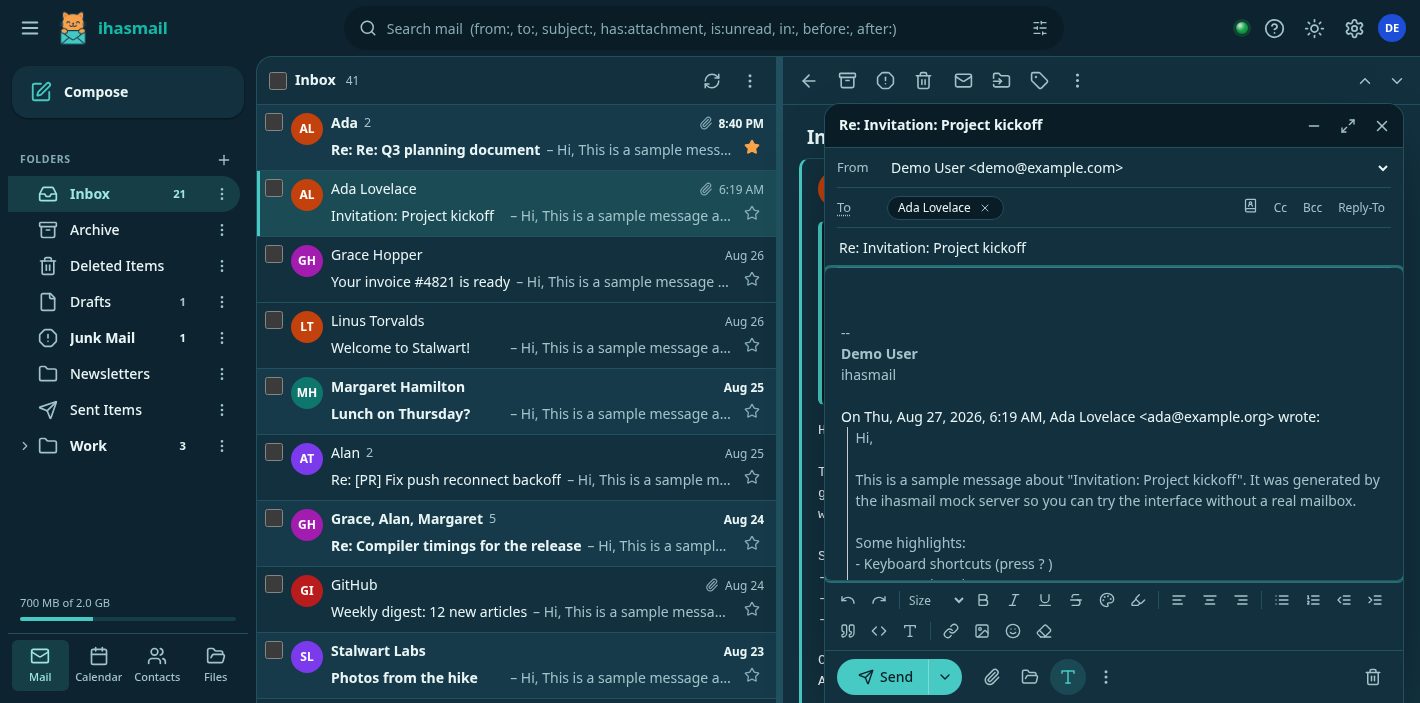 | **Calendar** 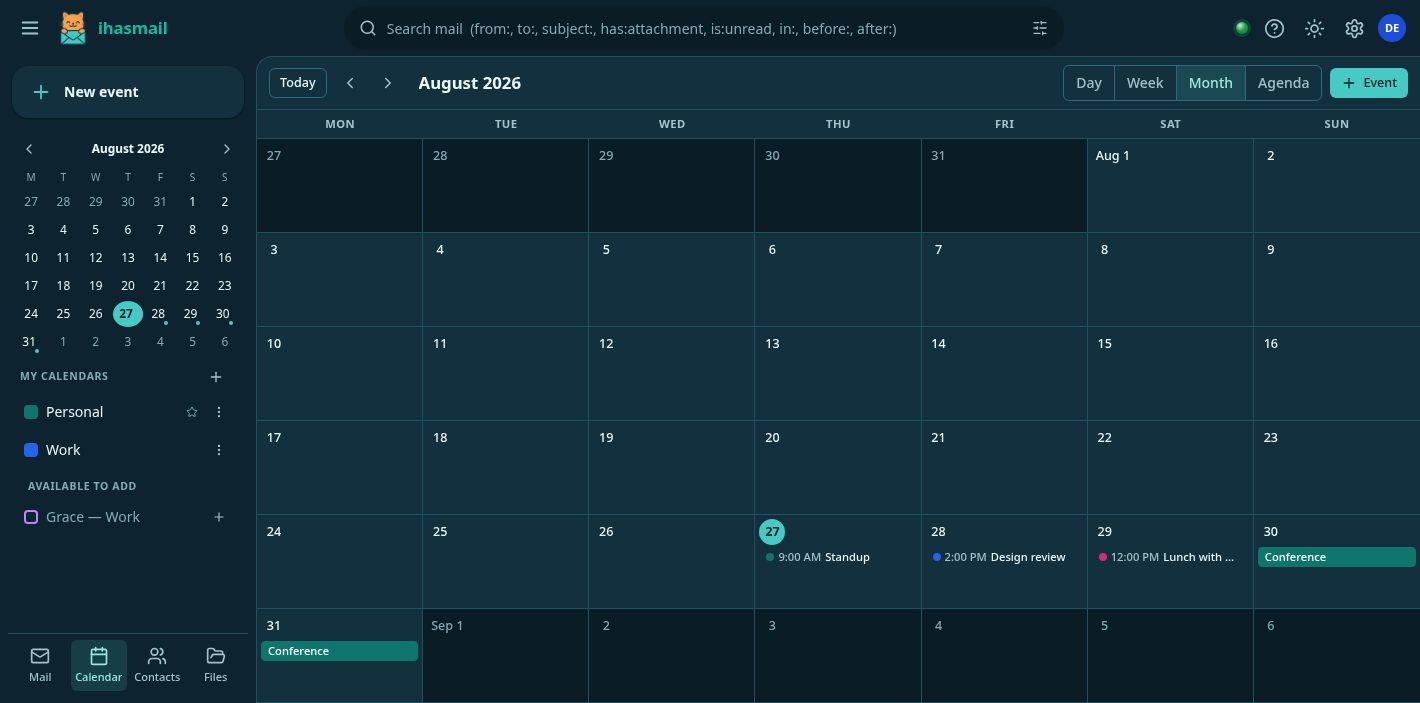 |
| **Contacts**  | **Sieve filter builder**  |
More, including the mobile layout, on [ihasmail.org](https://ihasmail.org/#screenshots).
## What's in it
- **Mail** — three-pane Gmail-style layout, conversation view, virtualised list, labels, undo, Gmail search operators and keyboard shortcuts, Sieve rules from a message's context menu, sanitised HTML with remote images blocked, read receipts, invitations and RSVP, an event made from a message with its guests already in it, multi-composer rich-text editing with signatures, scheduled send and undo send
- **Calendar** — JMAP Calendars / JSCalendar: month/week/day/agenda, recurrence, attendees and free-busy, colour categories
- **Contacts** — JMAP Contacts / JSContact: address books, groups, full editor, vCard import/export
- **Files** — JMAP FileNode: browse, upload, download, rename, move, delete
- **Settings that follow the account**, not the browser — kept in a `settings.json` in the account's own JMAP Files, so ihasmail itself stays stateless
- **Runs read-only** — one optional write path, and with it switched off the container needs no volume and no writable root. `IMMUTABLE=1` is checked at startup rather than trusted, so a half-applied switch refuses to boot instead of failing quietly. See [Running immutably](#running-immutably)
- **Nine new interface languages** — German, Spanish, French, Dutch, Portuguese (Brazil), Russian, Ukrainian, Simplified Chinese and Japanese, alongside English and separate from the date-and-time locale. Every one is marked **Beta**: they were made by AI and no native speaker has read them yet, which Settings says plainly, with a link for reporting anything wrong
- **On a phone** — swipe a message to archive or delete it (either direction, your choice), hold one to select it, hold a folder for its menu, pull the list to refresh, swipe back from a conversation
- **Platform** — installable PWA, Web Push with ihasmail closed, `mailto:` handler, no credentials in the browser, strict CSP, SSRF-safe image proxy
The long version is on [ihasmail.org](https://ihasmail.org/#features); how to
drive each one is in [Using ihasmail](https://docs.ihasmail.org/using/).
## Requires Stalwart 0.16 or newer
Sign-in refuses anything older, by name. 0.16 replaced the REST management API
with JMAP registry objects, changed the shape of `FileNode`, split its rights up
and moved configuration into the store; supporting both generations meant a
wrong guess had somewhere to fall back to, so it failed *quietly* — and that
reached production. With one supported generation a wrong guess is a loud error
on the first call.
- Still on 0.15? The last release that runs on it is tagged [`stalwart-0.15-support`](https://github.com/Coffey-Labs/ihasmail/releases/tag/stalwart-0.15-support).
- Upgrading? [stalwart-migrator](https://github.com/Coffey-Labs/stalwart-migrator) does it in place, checkpointing every phase and validating afterwards. The live instance moved 0.15.5 → 0.16.19 with eight seconds of downtime and nothing lost.
## Quick start (Docker)
```bash
cp .env.example .env
# edit: STALWART_URL=https://mail.example.com and APP_SECRET=$(openssl rand -base64 48)
docker compose up --build -d
# → http://localhost:8080 (put Caddy/nginx in front for TLS; see Caddyfile.example / nginx.example.conf)
```
Users sign in with their Stalwart mailbox credentials. **An account with
two-factor authentication needs an app password**, created in Stalwart's own
settings — Stalwart accepts a TOTP code only through an OAuth flow and offers no
password grant, so no client holding a username and password can exchange them
plus a code for a token.
Full instructions, TLS, and every environment variable:
[Installing](https://docs.ihasmail.org/install/) ·
[Configuring](https://docs.ihasmail.org/configure/).
### Running immutably
The server writes to exactly one path, the optional `SESSION_FILE`. Clear it
and there is nothing left to write, so the container can run with no writable
filesystem at all:
```bash
docker run --read-only --tmpfs /tmp -e IMMUTABLE=1 -e SESSION_FILE= ...
```
`IMMUTABLE=1` is an assertion the server checks at startup rather than a switch
that changes what it does: it refuses to start if `SESSION_FILE` is still set,
or if the filesystem it is installed on turns out to be writable after all.
Without it the same misconfiguration is silent — sessions are held in memory
and persisting them is best-effort, so a read-only `/data` costs one warning at
the first sign-in and nothing else until the instance is replaced and everyone
is signed out.
That sign-out is the standing cost of this mode today, since sessions have
nowhere to live across a restart. Removing it means moving the session upstream
into a token Stalwart itself issues and can revoke, which is what the OAuth work
in [ROADMAP.md](ROADMAP.md) is for.
### Settings the installation decides
A deployment can seed and lock user settings, which is what a school wanting
"warn about outside senders" on for three thousand pupils needs — asking three
thousand pupils is not a plan.
```bash
-e SETTINGS_DEFAULTS='{"externalSenderBanner":true}' \
-e SETTINGS_ENFORCED='{"externalRecipientConfirm":true}'
```
Three powers, and the differences between them matter:
| Section | Applies to | Reader can change it |
| --- | --- | --- |
| `defaults` | accounts that have never had settings of their own | yes, at any time |
| `enforced` | everyone, on every load | no — the control goes dead |
| `changes` | everyone, **once each**, including existing accounts | yes, afterwards, and it stays changed |
`changes` is the one that needs explaining. It turns something on for people who
are *already here* — the reason a plain default is not enough — while still
leaving them the last word. Each entry carries its own `version`, which every
account remembers once it has had it, so the change is applied exactly once per
person and a reader who turns it back off keeps it off. It is a schema migration
in shape, and that is deliberately whose idea it was ([#207]).
Nothing is configured by default: an installation that sets none of these
behaves exactly as ihasmail always has.
### Passing a policy to Docker
Where a file is easier to manage than JSON quoted in a unit file — and it
usually is once there are `changes` in it — mount one and name it:
```bash
docker run -d --name ihasmail \
-e STALWART_URL=https://mail.example.org \
-e APP_SECRET="$(openssl rand -hex 32)" \
-e SETTINGS_POLICY_FILE=/etc/ihasmail/policy.json \
-v /srv/ihasmail/policy.json:/etc/ihasmail/policy.json:ro \
-p 8080:8080 ghcr.io/coffey-labs/ihasmail:latest
```
```json
{
"defaults": { "externalSenderBanner": true },
"enforced": { "externalRecipientConfirm": true },
"changes": [
{ "version": "20260902084513", "settings": { "externalSenderBanner": true } },
{ "version": "20261014091500", "settings": { "externalLinkWarning": true } }
]
}
```
Mount it read-only: the server only ever reads it, and `:ro` keeps that true
under `--read-only` as well.
Or without a file at all, which is what an immutable deployment with no volume
wants:
```bash
docker run -d --name ihasmail --read-only --tmpfs /tmp \
-e IMMUTABLE=1 -e SESSION_FILE= \
-e STALWART_URL=https://mail.example.org \
-e APP_SECRET="$(openssl rand -hex 32)" \
-e SETTINGS_DEFAULTS='{"externalSenderBanner":true}' \
-e SETTINGS_ENFORCED='{"externalRecipientConfirm":true}' \
-e SETTINGS_CHANGES='[{"version":"20260902084513","settings":{"externalSenderBanner":true}}]' \
-p 8080:8080 ghcr.io/coffey-labs/ihasmail:latest
```
In `docker-compose.yml`:
```yaml
services:
ihasmail:
image: ghcr.io/coffey-labs/ihasmail:latest
environment:
SETTINGS_POLICY_FILE: /etc/ihasmail/policy.json
volumes:
- ./policy.json:/etc/ihasmail/policy.json:ro
```
A policy is read once at startup, so **editing it means restarting the
container**. There is no reload signal, deliberately: an installation-wide
setting changing under a running instance would be harder to reason about than
one that changes when you say so.
### Writing a policy
Both sections take the same names and values a settings export uses, so
`Settings → General → Export` on one account you have configured by hand is the
quickest way to write one — copy the keys you care about out of the file.
Three checks worth knowing about, because they fail loudly rather than quietly:
- **Malformed JSON stops the server at startup.** A policy that silently did not
apply is indistinguishable from the feature not working.
- **Every change needs a unique `version`.** Two changes sharing one, or a change
with no `version` or no `settings`, is a startup error.
- **Keys this build does not have are dropped**, the same rule an imported
settings file gets. A `changes` entry whose keys are *all* unknown is dropped
whole rather than recorded as applied, so it still runs on an ihasmail that
does have the setting.
Enforcement is applied in the settings store rather than only on the controls,
so an imported settings file, a settings file synced from a device that predates
the policy, and "reset to defaults" cannot get around it. Reset returns to your
defaults, not to ihasmail's.
[#207]: https://github.com/Coffey-Labs/ihasmail/issues/207
## Architecture
```
browser ──(same-origin /api/*)──► ihasmail server (Node + Hono) ──(JMAP over HTTPS)──► Stalwart
React SPA • session cookie ⇄ Basic auth
JMAP client + stores • /api/jmap, /api/blob, /api/upload, /api/events (SSE), /api/image
```
- `web/` — Vite + React 19 + TypeScript SPA. `src/jmap` (client, push, types), `src/store` (zustand: session, mail, compose, contacts, calendar, files, sieve, settings), `src/views`, `src/lib` (sanitiser, search parser, Sieve codec, locale-aware dates, vCard, …).
- `server/` — Node/Hono backend: authenticates against Stalwart's JMAP session endpoint, seals the credentials with a key derived from the cookie secret, proxies JMAP/blob/SSE, serves the SPA under a strict CSP. `src/mock/` is an in-memory fake Stalwart for development and demos.
Capabilities used: `core`, `mail`, `submission`, `vacationresponse`, `sieve`,
`contacts`(+`parse`), `calendars`(+`parse`), `principals`(+`availability`),
`quota`, `blob`, `filenode`, EventSource push, plus Stalwart's own
`urn:stalwart:jmap` (read-only). Features degrade gracefully when one is
missing.
## Development
Requirements: Node ≥ 20.10 (22 recommended), npm ≥ 10.
```bash
npm install
npm run dev # real Stalwart (STALWART_URL in .env) — server :8080, Vite :5173
npm run dev:mock # built-in mock Stalwart (demo@example.com / demo), mock on :8788
npm run dev:mock:no-future-release # mock that advertises FUTURERELEASE and drops every hold
npm run typecheck # tsc for both packages
npm test # vitest (web) + node:test (server)
npm run build # web/dist + server/dist
npm start # serve the production build
```
Open http://localhost:5173 in dev, or http://localhost:8080 for the production
build. Running it for real is covered in
[Installing](https://docs.ihasmail.org/install/) and
[Configuring](https://docs.ihasmail.org/configure/).
### The mock
An in-memory fake Stalwart 0.16 — enough JMAP to develop and demo against
without a real mailbox. It reproduces the things a naive fake would get wrong,
because each cost a live debugging session: `urn:stalwart:jmap` advertised
**per-account** rather than session-level, identity signatures capped at 2047
**bytes**, and `CalendarEvent/set` speaking Stalwart's vocabulary rather than
RFC 8984's. Two switches: `MOCK_NO_FUTURE_RELEASE=1` advertises FUTURERELEASE
and then drops every hold; `MOCK_NO_REGISTRY=1` omits the Stalwart capability so
the sign-in refusal can be tested.
### Version numbers
`ihasmail v2026.8.30+pr129` — the date of the commit this was built from, and
the pull request that commit arrived through. A commit that did not arrive
through one carries its short SHA instead: `2026.8.30+g1fa6578`. It all comes
from git at build time; nothing writes a version into the tree, and
`package.json` sits at `0.0.0` because it is no longer the source of anything.
The date is the commit's own rather than today's, so rebuilding an old commit
gives the version it had the first time.
```bash
node scripts/version.mjs # the version for the current checkout
docker build --build-arg IHASMAIL_VERSION="$(node scripts/version.mjs)" -t ihasmail:2026.8.30 .
```
`.dockerignore` excludes `.git` deliberately, so an image build cannot work this
out for itself — pass it in. Left out, the build reports `0.0.0`, which is meant
to look wrong: a version with no `+pr` or `+g` means whoever built the image did
not pass one.
The version says nothing about Stalwart, deliberately. It used to: `2.16.x` had
`16` for the 0.16 generation it targeted, which leaves nowhere to go once
Stalwart reaches 1.0 — `2.1` sorts *below* the `2.16` already deployed, so every
image and About screen would read as a downgrade. Which Stalwart a build needs is
stated where it can be precise, in the badge at the top of this file and in
[KNOWN-ISSUES.md](KNOWN-ISSUES.md), rather than compressed into one digit.
The pull request lives after the `+`, as build metadata, because it is
provenance rather than a rank: at the rate they merge here it climbs without
bound and says nothing about how new a build is. Everything after the `+` is
ignored when versions are compared, which is the right reading — two builds from
the same day differ in where they came from, not in age. Nothing here depends on
that comparison: images are pruned oldest-first by creation time, and a rollback
names a git ref.
### Deploying
[`deploy.example.sh`](deploy.example.sh) is a single-host Docker deploy: it
fetches, refuses anything held back by `.deploy-hold`, shows what is about to be
introduced and asks, rebuilds with the right version baked in, replaces the
container, waits for healthy, then prunes all but the newest
`IHASMAIL_KEEP_VERSIONS` images — never the one actually running.
```bash
./deploy.sh # origin/main, asks before shipping new commits
./deploy.sh --dry-run # run the guards and stop
./deploy.sh v2026.8.30 --yes # a named ref, no prompt (there is no tty over ssh)
```
`--yes` does not override a hold; clearing one means deleting its line.
## Contributing
[CONTRIBUTING.md](CONTRIBUTING.md) · [CODE_OF_CONDUCT.md](CODE_OF_CONDUCT.md) ·
[SECURITY.md](SECURITY.md) — please report vulnerabilities privately.
## License
Copyright (C) 2026 Coffey Labs — AGPL-3.0-or-later. See
[LICENSE](LICENSE).
ihasmail was relicensed from GPL-3.0 to AGPL-3.0 on 2026-08-25: webmail is
nearly always run as a network service rather than handed to anyone as a binary,
and the AGPL's section 13 closes that gap.
That offer has to point at *your* source, not this one. If you run a modified
ihasmail, set `SOURCE_URL` to your own repository — the sign-in page and
Settings › About both show it. See
[Rebranding](https://docs.ihasmail.org/rebranding/).